
Author

admin

Browsing

Even with a few short-lived roller coaster rides, the stock market had a strong week. Though there was some selling on Friday, the S&P 500 ($SPX) and Nasdaq Composite ($COMPQ) closed up over the week as a whole, while the Dow Jones Industrial Average ($INDU) closed lower by 0.07%.

Earnings season has started on a positive note, with big banks and Netflix, Inc. (NFLX) reporting better-than-expected earnings. Inflation remains relatively tame and the labor market remains resilient. This has helped fuel the stock market’s higher trajectory, with sectors such as Technology, Industrials, and Financials showing strong upward moves.  Even small-caps are hanging in there, although they have pulled back a bit.

This price action supports broad participation in the market. The S&P 500 Equal-Weighted Index ($SPXEW) is also holding strong, trading above its 20-day exponential moving average. This tells us that participation isn’t limited to a handful of giants.

A Look Under the Hood

Overall growth still takes center stage and, so far, July is following its seasonality pattern. The seasonality chart below shows that in the last 10 years, the return in July was positive every year, with an average gain of 3.30%.

FIGURE 1. SEASONALITY CHART OF THE S&P 500. July is a strong month for the index, but August, September, and October paint a different picture.Image source: StockCharts.com. For educational purposes.

Switching to a same-scale line chart (with a few years removed for clarity) you can see that even in 2020 and 2022, when the S&P 500 was in negative territory, July was still a strong month.

FIGURE 2. SAME-SCALE SEASONALITY CHART FOR S&P 500 FROM 2016 TO 2025. July is a strong month for stocks, although some years the latter part of the month has seen a decline.Image source: StockCharts.com. For educational purposes.

Seasonality shifts notably as we move into late summer and early fall. That doesn’t guarantee a weak August, but it does argue for staying alert. It’s like driving into a stretch of winding road. You don’t slam the brakes, you just keep both hands on the wheel.

How to Track the Overall Market’s Performance

For a bird’s-eye view, the StockCharts Market Summary is your go-to page, but, after drilling down, one chart I often visit in my Market Analysis ChartList is the 3-year weekly chart of the S&P 500, with its Bullish Percent Index (BPI) and the percentage of S&P 500 stocks trading above their 200-day moving average.

FIGURE 3. WEEKLY CHART OF S&P  500 WITH MARKET BREADTH INDICATORS. From a weekly perspective, the S&P 500 is still trending higher. Breadth indicators support the bullish move.Chart source: StockCharts.com. For educational purposes.

The trend is still higher, although the range between the open and close is relatively narrow. The BPI is above 50 but is flattening out, and the percentage of stocks trading above their 200-day moving average is also declining. Neither breadth indicator suggests we’ll see a massive selloff in the coming days.

The Cboe Volatility Index ($VIX) is low, and investor sentiment leans bullish (you can confirm this in the Sentiment panel of the Market Summary page).

Will Growth Lead For the Rest of the Year?

There are lots of variables that can change from now to the end of the year, from government policy to geopolitical tensions. These changes will be reflected in the market breadth and sentiment charts.

Tip: StockCharts members can download the Market Summary ChartPack to include the charts from the page in their ChartLists. You need to keep an eye on these charts for leading signals of change in the market’s price action.


End-of-Week Wrap-Up

Stock Market Weekly Performance

  • Dow Jones Industrial Average: 44,342.19 (-0.07%)
  • S&P 500: 6,296.79 (+0.59%)
  • Nasdaq Composite: 20,895 (+1.51%)
  • $VIX: 16.41 (+0.06%)
  • Best performing sector for the week: Technology
  • Worst performing sector for the week: Energy
  • Top 5 Large Cap SCTR stocks:  AST Spacemobile, Inc.(ASTS); Nuscale Power Corp. (SMR); Robinhood Markets Inc. (HOOD); Avis Budget Group (CAR); Symbiotic, Inc. (SYM)

On the Radar Next Week

  • June Home Sales
  • June Durable Goods Orders
  • Several Fed speeches
  • Earnings from Alphabet, Inc. (GOOGL), Tesla, Inc. (TSLA), AT&T Inc. (T), Intel Corp. (INTC), International Business Machines (IBM), and many more.

Disclaimer: This blog is for educational purposes only and should not be construed as financial advice. The ideas and strategies should never be used without first assessing your own personal and financial situation, or without consulting a financial professional.

This week, let’s dive into three interesting stocks: a well-known Dow stalwart, a tech giant in a tug of war, and a former Dow member showing signs of revival. Whether you’re looking for opportunity, caution, or something worth watching, there’s a little something here for every thoughtful investor.

Sherwin-Williams (SHW): Painting a Better Picture?

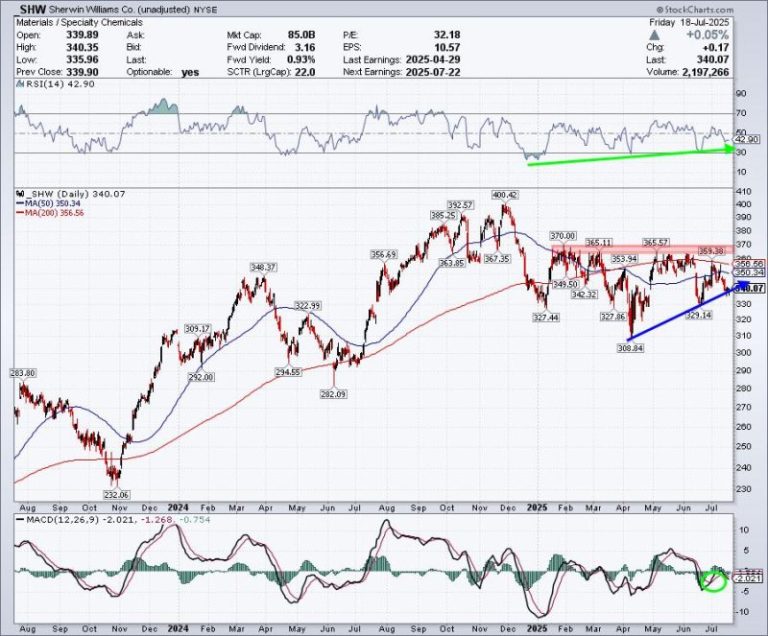
Sherwin-Williams, Co. (SHW) comes into earnings flat year-to-date, and is hoping that a solid quarterly result can turn the price around. This Dow stock, and the second biggest member of the Materials Select Sector SPDR ETF (XLB), has traded higher after three of its last four results and has an average expected move of +/- 3.6% when it reports.

FIGURE 1. DAILY CHART OF SHERWIN-WILLIAMS. The uptrend needs to hold to maintain the uptrend.Chart source: StockCharts.com. For educational purposes.

From a technical perspective, there are some bright spots. The reality, however, is that the stock has a lot of work to do to be considered healthy again. And from a risk/reward metric, this recent uptrend from the lows needs to hold. Otherwise, look for a retest of the $310 level on a dip.

The good, the bad, and the ugly:

Shares continue to make higher lows, which is a bullish sign

There’s bullish divergence in its Relative Strength Index (RSI) — it’s going higher while the stock stalls

The MACD gave us a short-lived buy signal and has now turned negative

Trading below both key moving averages

There’s major resistance at the $360 level

This is one to put on your watchlist, with definitive risk/reward levels to monitor. To jump in ahead of earnings seems more of a crapshoot, so reacting to price action may be the best play. Patience may be your best friend.

Alphabet (GOOGL): A Mag Stock or Just Mag History?

Alphabet, one of the “Magnificent 7” stocks, has had a rough ride lately. The company has been facing continual headwinds due to antitrust and litigation risk, AI competition disrupting search, and a massive CapEx spend.

Shares have been stuck in neutral for the last year. They are lower by -2.5% year-to-date and 11% off all-time highs. If the company can address these concerns and focus on the positives of its YouTube and Waymo divisions, it could be back on the upswing.

FIGURE 2. DAILY CHART OF GOOGL STOCK. It’s in the middle of a rebound and could be at an interesting pivot point.Chart source: StockCharts.com. For educational purposes.

Technically, I will keep this five-year daily chart as simple as possible. It’s intriguing, to say the least.

GOOGL was dangerously close to breaking down in early April, but quickly regained its key support level. Now it finds itself in the middle of a nice rebound and at an interesting pivot point. The bull case is more concrete at these levels, but I’m sure the bears are looking at a potential head-and-shoulders topping formation in the works as well.

As we examine, watch the 50 and 200-day moving averages closely. They are at a key consolidation area and need to act as support in a small downturn. If not, then back to the major support area we go, and a potential head-and-shoulders top is in play. 

The good news is that overall momentum continues to favor the upside. We have a good support area at the averages (your risk) and then a potential run to $200 easily if we get a nice pop on earnings. If so, this could be the fourth of the “Magnificent 7” stocks trading at all-time highs.

Intel (INTC): A Blast From the Past, Showing Signs of Life?

Remember Intel? It once dominated the landscape during the dot-com era, was a proud member of the Dow, and now is just a struggling former tech giant trying to stay relevant in a challenging environment. We are not claiming they are back by any stretch, but maybe the worst is over for now, as new management and constructive price action have set up a “deja vu” trade that hearkens back to early 2023.

FIGURE 3. WEEKLY CHART OF INTC STOCK. The stock is above its 50-week moving average, there’s a bullish divergence in the RSI and MACD, and the bottom base was tested several times.

Chart source: StockCharts.com. For educational purposes.

Technically, we highlight price action daily over a five-year weekly period. The risk/reward set-up seems quite favorable at current levels and also looks eerily similar to its last rebound.

Here’s the current scenario that also occurred in 2022/2023.

Bottom/base that was tested multiple times and held

Bullish divergence in both key momentum indicators – RSI and MACD

Price followed and broke above the 50-week moving average

Price was over 40% below its 200-week moving average — something to reverse

In 2023, shares rallied back. Will this situation resolve similarly?

The risk to the downside seems worth the possible reward up to the moving average. Whether or not the stock has turned it around completely is a different story, but for now, the tide seems to be shifting. 

The Bottom Line

These three stocks offer a mix of opportunity and caution. Be sure to add these stock to your ChartLists and watch the action unfold as the companies report earnings.


Here’s a quick recap of the crypto landscape for Friday (July 18) as of 9:00 p.m. UTC.

Get the latest insights on Bitcoin, Ethereum and altcoins, along with a round-up of key cryptocurrency market news.

Bitcoin and Ethereum price update

Bitcoin (BTC) was priced at US$117,488, down by 1.3 percent in the last 24 hours. The day’s range for the cryptocurrency brought a low of US$117.409 and a high of US$119,529.

Bitcoin price performance, July 18, 2025.

Chart via TradingView.

After hitting new highs this week, supported by optimism around US crypto legislation and continued institutional inflows, Bitcoin is consolidating. The crypto market is currently seeing a capital rotation from Bitcoin to altcoins, with Ethereum’s token, ETH, exhibiting an exceptionally strong run.

Ethereum (ETH) was priced at US$3,555.99, up by 3.9 percent over the past 24 hours. Its lowest valuation on Friday was US$3,541.70, and its highest was US$3,657.81.

Altcoin price update

  • Solana (SOL) was priced at US$117.28, up by 1.6 percent over 24 hours. Its lowest valuation on Friday was US$176.32, and its highest was US$181.52.
  • XRP was trading for US$3.44, up 3.1 percent in the past 24 hours. The cryptocurrency’s lowest valuation was US$3.36, and its highest was US$3.52.
  • Sui (SUI) is trading at US$3.80, down by four percent over the past 24 hours and its lowest valuation of the day. Its highest was US$4.01.
  • Cardano (ADA) was trading at US$0.8176, up by 1.9 percent over 24 hours. Its lowest violation was US$0.8152 while its highest was US$0.8591.

Today’s crypto news to know

GENIUS Act becomes law

US President Donald Trump signed the GENIUS Act into law on Friday, establishing the first federal regulatory framework for stablecoins in the US. This marks a significant development for digital assets.

The act will take effect 18 months after the date of enactment, or 120 days after the primary federal payment stablecoin regulators issue any final implementing regulations.

In a statement, Securities and Exchange Commission (SEC) Chair Paul Atkins congratulated the House on the accomplishment, which was preceded by a tumultuous period on Tuesday (July 15) that saw a procedural vote fail.

This was followed by a successful bipartisan vote on Wednesday (July 16) to advance the bill, culminating in its overwhelming passage on Thursday (July 17). Atkins added that he will look forward to watching the market leverage the regulatory framework provided by the GENIUS Act” over the coming months and years.

Stablecoins are used to facilitate trading, payments, and transfers within the crypto ecosystem without the volatility of traditional cryptocurrencies like Bitcoin. Secretary of the Treasury Scott Bessent recently suggested that the law could help grow the stablecoin market to US$3.7 trillion by 2030.

Two other bills also passed the House during the so-called “Crypto Week”: one defining which crypto assets are securities or commodities, and another barring the Federal Reserve from launching a US central bank digital currency.

These bills will now proceed to the Senate, but the Genius Act’s passage alone is already being hailed as a defining moment in the evolution of US crypto regulation.

Crypto market soars past US$4 trillion

The global market capitalization of the crypto sector has topped US$4 trillion for the first time, spurred by optimism following the US House’s passage of federal stablecoin legislation.

Investors are piling into altcoins and crypto-related equities as momentum builds behind Crypto Week in Washington. Ether led the charge with a 22 percent jump over five days, while Bitcoin soared to an all-time high of US$123,205 and continues to make up over half of the market’s total value.

The gains reflect confidence that a regulatory framework is finally taking shape in the world’s largest economy.

Analysts predict that the stablecoin sector alone could balloon to US$3.7 trillion by 2030, especially with state and federal guardrails in place. Exchange-traded fund inflows have been particularly strong this month, with US-listed Bitcoin and Ether funds attracting a combined US$8.4 billion in July.

SharpLink to raise US$6 billion for ETH acquisition

Following a 16,370 ETH acquisition on Sunday (July 13), a prospectus supplement filed with the SEC by online performance marketing company SharpLink on Thursday revealed the company increased the amount of common stock it can sell by an extra US$5 billion. Added to the US$1 billion in its initial May 30 filing, this brings the total offering to US$6 billion. SharpLink said it would use the funds to acquire more ETH.

Executive order will reportedly allow crypto in 401(k)s

Trump is reportedly expected to sign an executive order allowing American 401(k) retirement plans to include alternative assets like cryptocurrencies, as well as gold and private equity.

This development was reported by the Financial Times on Thursday, citing three individuals briefed on the plans, who added that the order would direct regulatory agencies to investigate the remaining hurdles preventing alternative investments in professionally managed funds.

In response, SEC Chair Paul Atkins expressed openness to the inclusion of cryptocurrencies in 401(k) retirement plans during an appearance on Bloomberg Talks, but emphasized the critical need for investor education.

Atkins has also indicated that the SEC is considering an innovation exemption within its regulatory framework. This exemption would aim to facilitate new trading methods and offer targeted relief to foster the growth of a tokenized securities ecosystem.

Securities Disclosure: I, Giann Liguid, hold no direct investment interest in any company mentioned in this article.

Securities Disclosure: I, Meagen Seatter, hold no direct investment interest in any company mentioned in this article.

This post appeared first on investingnews.com

China is solidifying its position as the primary engine for global platinum demand

Record participation in Shanghai Platinum Week underscores the country’s expanding influence in a market facing a deepening supply deficit. The event, which attracted over 590 delegates from 30 countries, took place at a critical moment — just as the platinum market is tightening and a supply shortfall is deepening through 2029.

The World Platinum Investment Council (WPIC) notes that China now accounts for 64 percent of global demand for platinum bars and coins — up from 11 percent in 2019 — driven largely by investors seeking alternatives to gold.

“Platinum demand in China is continuing to expand, as the growth in physical platinum investment we are currently witnessing demonstrates,” said WPIC CEO Trevor Raymond, who also warned of persistent market tightness to 2029.

Also during the event, Valterra Platinum (JSE:VAL) CEO Craig Miller delivered his first public address in Asia since the company’s high-profile demerger from Anglo American (LSE:AAL,OTCQX:AAUKF) in May.

Miller confirmed Shanghai as one of Valterra’s three new international marketing hubs, emphasizing the company’s intent to shape demand within China’s growing platinum-group metals (PGMs) ecosystem.

“Attending Shanghai Platinum Week has highlighted its value for connecting with the PGM market in China,” he said. “Shaping demand for PGMs through market development remains an integral part of our strategy.”

Although new tariffs are expected to dent platinum demand by an estimated 112,000 ounces in 2025, that 1.4 percent decline is being far outweighed by a boom in investment and jewelry consumption.

The Chinese jewelry sector, too, is undergoing a transformation. Wholesalers are commissioning stock that mimics popular gold designs, making platinum jewelry more accessible and appealing to retailers and consumers alike.

If this trend continues, the WPIC forecasts a sharp rise in jewelry-related platinum usage from 2026 onward.

Platinum market fundamentals also remain tight, with supply expected to lag behind growing demand through at least 2029. Several Chinese refiners have recently secured “good delivery” accreditation from the London Platinum and Palladium Market, bolstering investor confidence and strengthening the local trading ecosystem.

Beyond investment and jewelry, regulatory and industrial shifts are setting the stage for long-term structural demand. China’s upcoming China VII/7 vehicle emissions standards, due to take effect in 2026, are expected to significantly increase PGMs loadings per vehicle due to more stringent cold start and real-world emissions testing.

Meanwhile, a global phaseout of mercury-based catalysts in polyvinyl chloride manufacturing is likely to drive adoption of platinum-based alternatives by 2030. In the hydrogen economy — a sector widely seen as platinum’s next frontier — the outlook remains bullish. Installed global electrolysis capacity is forecast to reach 100 gigawatts by 2030, with platinum-intensive proton exchange membrane (PEM) technology expected to dominate nearly half the market.

“This year we were delighted to welcome more overseas interest than ever before,” said Raymond. “Platinum investment is a natural mechanism for attracting metal into any geography, providing a pool of liquidity to supply future demand — particularly vital for countries like China, which rely on imports and recycling for supply.”

The week also celebrated Shanghai Platinum Week’s fifth anniversary with the unveiling of a commemorative 999.5 platinum medal designed by master engraver Luo Yonghui, limited to just 200 pieces.

Securities Disclosure: I, Giann Liguid, hold no direct investment interest in any company mentioned in this article.

This post appeared first on investingnews.com

The US government has imposed a 93.5 percent anti-dumping tariff on battery-grade graphite imports from China, targeting what officials have described as unfairly low-priced shipments.

They claim domestic producers have been undercut, and have cited concerns over critical minerals dependence.

The US Department of Commerce announced the duty on Thursday (July 17) after an investigation prompted by from US manufacturers, who argued that Chinese producers were flooding the market with underpriced graphite.

The new duty, when combined with existing countervailing tariffs, raises the total effective rate to around 160 percent, according to the American Active Anode Material Producers (AAAMP), the coalition that filed the complaint.

The move affects roughly US$347 million worth of Chinese graphite imports, according to commerce department estimates, and comes as US policymakers scramble to secure critical mineral supply chains.

“Commerce’s determination proves that China is selling [active anode material] at less than fair value into the domestic market,” Erik Olson, a spokesperson for AAAMP, said in a Thursday press release.

The department said final rulings on both anti-dumping and anti-subsidy investigations will be announced by December 5.

A separate ruling in May placed a 6.55 percent preliminary countervailing duty on most Chinese producers, but singled out Huzhou Kaijin New Energy Technology and Shanghai Shaosheng for exceptionally high rates — 712.03 percent and 721.03 percent, respectively.

Graphite’s importance draws new scrutiny

While graphite rarely draws headlines like lithium or cobalt, it comprises up to 50 kilograms of every electric vehicle (EV) battery, forming the anode — a component as essential as the more widely discussed cathode.

China accounts for roughly 95 percent of global anode production, according to data from SNE Research.

Imports from China represented two-thirds of the 180,000 metric tons (MT) of graphite products shipped to the US in 2023, BloombergNEF data shows. Industry analysts say the new duties could significantly reshape market economics — especially for foreign battery suppliers that serve US automakers.

Supporters of the decision, including domestic producers and some lawmakers, argue the tariffs are a long-overdue corrective measure to level the playing field and stimulate US production.

“The decision today underscores the strategic importance of building a domestic supply chain for critical minerals, including synthetic graphite, in North America,” said Michael O’Kronley. “It affirms our business strategy as well as the diversification strategy of our customers to source critical battery materials and components locally.’

O’Kronley is CEO of Novonix (ASX:NVX,NASDAQ:NVNXF), which is building one of the largest synthetic graphite facilities in North America with support from a US$750 million US Department of Energy loan.

Westwater Resources (NYSEAMERICAN:WWR), which is constructing a graphite plant in Alabama, said the ruling provides the policy clarity and market signals needed to accelerate domestic graphite production.

“These two rulings by the DOC are distinct from legislative-driven global trade tariffs,” said Chief Commercial Officer Jon Jacobs in a statement of support. “They reflect long-term support for US-based graphite production.”

The company expects to produce 12,500 MT of graphite in 2026 and ramp up to 50,000 MT annually by 2028.

Despite efforts to boost local production, US automakers and battery makers warn that domestic graphite supply remains years away from meeting commercial demand — either in scale or purity.

In filings with the commerce department, Tesla (NASDAQ:TSLA) cautioned that US producers have yet to demonstrate the technical ability to deliver the quality needed for EV batteries. Panasonic (OTC Pink:PCRFF,TSE:6752) echoed similar concerns, and both companies opposed the tariff earlier this year.

This leaves companies with a difficult choice: pay sharply higher prices for Chinese imports or risk shortages from an unproven local market.

Trade frictions add to supply chain strain

The timing complicates matters further. Just days before the US tariff announcement, China finalized new export controls on key battery technologies, including those used in lithium iron phosphate (LFP) cells — an area where China leads globally. The combination of trade restrictions on both sides is stoking fears of a wider resource standoff.

For US automakers, the downstream pressure is immediate. The tariff could wipe out up to 20 percent of the value of production tax credits under the Inflation Reduction Act, while added import costs may ripple through the supply chain.

Higher battery costs could also push EV sticker prices further upward, straining affordability and slowing adoption.

But experts caution that breaking China’s dominance in graphite will not be quick or easy. According to the International Energy Agency, developing alternative supply chains for battery materials could take years, if not decades — especially given the high purity and consistency required in EV-grade materials.

Still, supporters argue the short-term pain is worth the strategic payoff. “It’s a very strong signal that they are intent on fostering an ex-China supply chain,” Ben Lyons of Jarden told the Financial Times.

Securities Disclosure: I, Giann Liguid, hold no direct investment interest in any company mentioned in this article.

This post appeared first on investingnews.com

Gold Price Surge Hits $3,385 Amid Trade Tensions

The gold price surge continued on April 21, 2025, as gold hit a record high of $3,385 per ounce. This milestone came amid a weakening U.S. dollar and renewed global trade tensions. Investors are increasingly turning to gold as a safe-haven asset, signaling market uncertainty and shifting investment strategies.

Gold Price Increase Driven by Dollar Weakness

The U.S. dollar index fell sharply, hitting its lowest level since January 2024. A weaker dollar typically boosts gold prices, as it makes the metal more attractive to international buyers. This contributed significantly to the ongoing gold price surge seen in recent weeks.

In addition, economic data indicating slower growth in key global markets has prompted investors to reduce their exposure to riskier assets. Gold’s long-standing reputation as a hedge against economic uncertainty has once again proven true.

Trade Tensions Fuel Demand for Safe-Haven Assets

Ongoing trade friction between major economies—particularly the U.S. and China—has triggered market anxiety. Announcements related to new tariffs and supply chain risks are further motivating the shift from equities to gold. This environment is ideal for a gold price surge to gain momentum.

Analysts Predict Continued Gold Price Growth

Market analysts suggest that the upward trend is far from over. If inflation persists and interest rates remain steady or fall, the gold price could climb even higher. Some predict that the next psychological barrier of $3,500 per ounce may soon be tested.

As the global economic landscape continues to evolve, gold is expected to remain a central pillar in investor portfolios. Whether as a hedge against inflation or a response to geopolitical unrest, the gold price surge is being closely monitored by financial experts.

Source: Yahoo Finance

Related: Market Insights | Commodity News

The post Gold Price Surge Hits $3,385 Amid Trade Tensions appeared first on FinanceBrokerage.

BNB Price Surge Leads Crypto Gains as Bitcoin Climbs

The BNB price surge on April 21, 2025, stole the spotlight as Binance Coin jumped over 3.2% to cross the $600 mark. This move came as Bitcoin soared past $87,000, reigniting investor interest in altcoins. The bullish wave didn’t stop with BNB—SOL and XRP also made strong moves, reflecting a positive trend across the cryptocurrency market.

BNB Price Surge Driven by Token Burn and Momentum

Fueling the BNB price surge was Binance’s recent $1 billion token burn, which reduced the circulating supply. Additionally, increased trading volumes and renewed faith in Binance’s ecosystem helped BNB regain upward momentum. Investors are optimistic that Binance’s expansion and focus on compliance could drive long-term growth.

SOL Rally and XRP Breakout Add to Market Optimism

Solana (SOL) saw a 10.2% rally, breaking above the $135 resistance level with strong volume and technical confirmation. XRP, on the other hand, climbed past $2.10, setting the stage for a potential breakout above $2.15. These moves indicate bullish setups that are gaining attention from both traders and long-term holders.

Bitcoin Reinforces Its Role as Digital Gold

Bitcoin’s rise above $87,000 reflects renewed demand for a digital safe-haven. With increasing global economic uncertainty and inflation concerns, many investors view Bitcoin as “digital gold.” This sentiment is spilling over into altcoins, triggering the current crypto rally.

Conclusion and Market Outlook

The BNB price surge highlights growing investor confidence in altcoins. Alongside Bitcoin’s strength, tokens like SOL and XRP are enjoying increased attention. If this trend continues, more gains could be ahead for altcoin markets. Investors should monitor resistance levels and trading volumes closely for signs of sustained momentum.

Source: Yahoo Finance

Related: Crypto Updates | Market Trends

The post BNB Price Surge Leads Crypto Gains as Bitcoin Climbs appeared first on FinanceBrokerage.

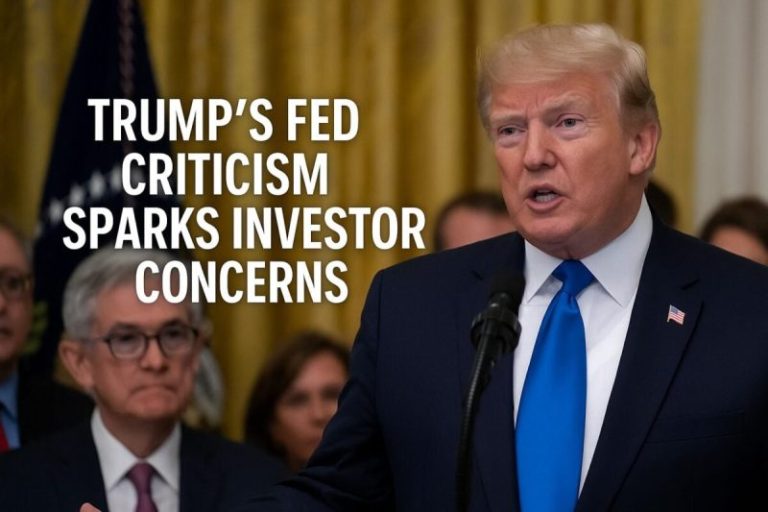
Trump’s Fed Criticism Sparks Investor Concerns

The recent spotlight on Trump’s Fed Criticism has sparked unease among investors and financial analysts alike. President Donald Trump’s repeated public attacks on Federal Reserve Chair Jerome Powell have amplified concerns over the central bank’s independence. As a result, markets have reacted with volatility, and investor sentiment has taken a noticeable hit.

Market Reactions to Political Pressure

Wall Street’s response to Trump’s Fed Criticism was swift. Major stock indices, including the S&P 500 and Nasdaq, posted losses amid uncertainty over future monetary policy decisions. Investors fear that political attempts to sway the Federal Reserve’s agenda may undermine its objectivity. If monetary policy is dictated by short-term political goals rather than long-term economic data, the implications could be severe for inflation, interest rates, and overall economic health.

Why Federal Reserve Independence Matters

One of the cornerstones of a stable economy is a politically neutral central bank. Trump’s Fed Criticism has called that neutrality into question. The Federal Reserve must be able to act without external pressure to maintain credibility in the eyes of global markets. Political interference could compromise its ability to control inflation or manage unemployment rates effectively.

Investor Sentiment and Future Outlook

Investor confidence remains fragile. Many market participants have shifted assets into safer investments such as gold and U.S. treasuries, seeking shelter from potential turmoil. Economic advisors stress the importance of maintaining clear, data-driven policy guidance, especially as the U.S. navigates ongoing trade issues and inflation concerns.

In the coming weeks, the Federal Reserve’s actions will be closely watched. Should Trump’s Fed Criticism intensify, it could further erode market stability and investor trust in U.S. monetary policy.

Source: Yahoo Finance


The post Trump’s Fed Criticism Sparks Investor Concerns appeared first on FinanceBrokerage.